

How can chews help my dog’s teeth?
With the appropriate chewing device, the mechanical action can help slow down the accumulation of plaque and tartar on your dog’s teeth. Not all products for chewing are good, however, because larger, harder ones could break your dog’s teeth. Some chews may contain additional ingredients that help fight the plaque as well.
Below are some products that Virbac has developed to provide a selection of choices to suit your dog’s needs. Regular use of an appropriate chew can be one part of a complete dental care program that will include examinations and professional care from your veterinarian. If you have questions about any of these products, be sure to talk with your veterinarian. As with any product, always listen to your veterinarian’s instructions and read the product label.

Click image to enlarge
C.E.T.® VEGGIEDENT® Tartar Control Chews for Dogs
These tasty vegetable-based chews have an easy-to-hold "Z" shape, and a tough, chewy consistency that dogs love.
Not available for sale in New Mexico.

Need a little help remembering when to give your pet its meds? Let us help with REMIND ME® System.
Are C.E.T.® VEGGIEDENT® Tartar Control Chews for Dogs hypoallergenic?
C.E.T. VEGGIEDENT Chews are vegetable based chews and do not contain any animal proteins. C.E.T. VEGGIEDENT Chews do contain grain proteins.
How many calories are in C.E.T. VEGGIEDENT Chews?
The calorie content varies on the size of the chew: Small: 85 KCalories; Regular: 119 KCalories.
Click image to enlarge
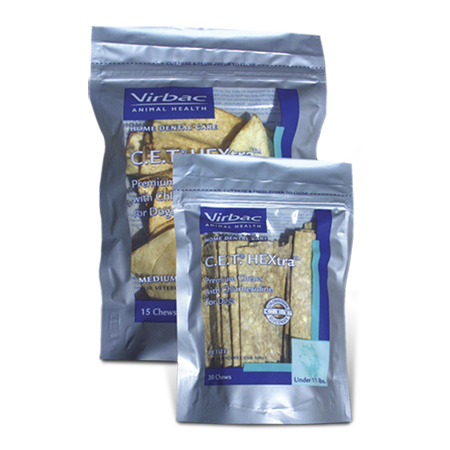
C.E.T.® HEXTRA® Premium Chews for Dogs
Combines chewy rawhide and the proven antiseptic power of chlorhexidine to reduce plaque and tartar buildup.
Not available for sale in New Mexico.
Need a little help remembering when to give your pet its meds? Let us help with REMIND ME® System.
What is the protein source for C.E.T.® HEXTRA® Chews for Dogs?
The chews contain both beef and poultry proteins.
How many calories are in C.E.T. HEXTRA Chews?
The calorie content varies depending on the size of each chew.
Petite: 29 KCalories, Medium: 30 KCalories, Large: 63 KCalories and Extra Large: 86 KCalories
What is the difference between C.E.T. HEXTRA Chews and C.E.T.® Enzymatic Oral Hygiene Chews for Dogs?
C.E.T. HEXTRA Premium Chews are made using the unique and proprietary binding-releasing system to ensure maximal release of chlorhexidine, which helps reduce plaque and calculus. The chlorhexidine is released into the oral cavity during chewing and may be released for up to 24 hours, providing sustained antimicrobial action.1,2 C.E.T. Enzymatic Oral Hygiene Chews feature an exclusive Dual-Enzyme System that produces a natural antiseptic plus a coarse texture that works with the dog’s chewing action to reduce plaque and calculus.
- Pader, Morton. Oral Hygiene Products and Practice. New York: Marcel Dekker, Inc., 1988.
- Bonesvoll, P “Oral Pharmacology of Chlorhexidine.” Journal of Clinical Periodontology, 4.5(1977): 49-65.
Where do the hides come from to make C.E.T. HEXTRA Chews?
The hides used to make our rawhide chews come from North American cattle.
My dog is prone to developing urinary bladder stones. Can I give him C.E.T.® HEXTRA® Premium Chews for Dogs?
Many underlying factors can contribute to the formation of urinary crystals and stones. Diet plays a significant role, and feeding diets high in protein can promote the development of crystals and stones in the urinary bladder.1
Since rawhide chews are high in protein, doctors from the Veterinary Clinical Sciences Department at the University of Minnesota College of Veterinary Medicine Urolith Center do not recommend feeding them to dogs with urinary bladder crystals or stones.2 Additionally, Virbac has no safety studies for use of C.E.T. HEXTRA Premium Chews in dogs with urinary bladder stones or crystals.
Daily brushing is the best way to protect your dog’s dental health and may be another option for your dog. Virbac manufactures several flavors of toothpastes along with toothbrushes of various kinds for dogs and cats. Although Virbac has no safety studies for use of these toothpastes in dogs with urinary stones or crystals, dogs ingest very little toothpaste to pose a problem when used according to label directions.2
As always, your veterinarian is the best source of information regarding the health and well-being of your dog.
- Osborne CA, Lulich JP, Kruger JM, Ulrich LK, Koehler LA Analysis of 451,891 canine uroliths, feline uroliths and feline urethral plugs from 1981 to 2007: perspectives from the Minnesota Urolith Center. Veterinary Clinics of North America Small Animal Practice. 2009; 39:183.
- Koehler LA, Osborne CA, Lullich JP, Behnke R Canine Uroliths: Frequently Asked Questions and Their Answers. Veterinary Clinics of North America Small Animal Practice. 2008; 39: 161-181.

Click image to enlarge
C.E.T.® Enzymatic Oral Hygiene Chews for Dogs
Made from select beefhide, these chews control plaque and are basted with a great poultry flavor that dogs love.
Not available for sale in New Mexico.
Need a little help remembering when to give your pet its meds? Let us help with REMIND ME® System.
What is the difference between C.E.T.® Enzymatic Oral Hygiene Chews and C.E.T.® HEXTRA® Premium Chews for Dogs?
C.E.T. Enzymatic Oral Hygiene Chews feature an exclusive Dual-Enzyme System that produces a natural antiseptic plus a coarse texture that works with the dog’s chewing action to reduce plaque and calculus. C.E.T. HEXTRA Premium Chews are made using the unique and proprietary binding-releasing system to ensure maximal release of chlorhexidine, which helps reduce plaque and calculus. The chlorhexidine is released into the oral cavity during chewing and may be released for up to 24 hours, providing sustained antimicrobial action.1,2
- Pader, Morton. Oral Hygiene Products and Practice. New York: Marcel Dekker, Inc., 1988.
- Bonesvoll, P “Oral Pharmacology of Chlorhexidine.” Journal of Clinical Periodontology, 4.5(1977): 49-65.
What is the protein source for C.E.T. Enzymatic Oral Hygiene Chews?
The chews contain both beef and poultry proteins.
How many calories are in C.E.T. Enzymatic Oral Hygiene Chews?
The calorie content varies depending on the size of each chew.
Petite: 27 KCalories, Medium: 31 KCalories, Large: 65KCalories and Extra Large: 89 KCalories
Where do the hides come from to make C.E.T. Enzymatic Oral Hygiene Chews?
The hides used to make our rawhide chews come from North American cattle.
My dog is prone to developing urinary bladder stones. Can I give him C.E.T.® Enzymatic Oral Hygiene Chews for Dogs?
Many underlying factors can contribute to the formation of urinary crystals and stones. Diet plays a significant role, and feeding diets high in protein can promote the development of crystals and stones in the urinary bladder.1
Since rawhide chews are high in protein, doctors from the Veterinary Clinical Sciences Department at the University of Minnesota College of Veterinary Medicine Urolith Center do not recommend feeding them to dogs with urinary bladder crystals or stones.2 Additionally, Virbac has no safety studies for use of C.E.T. Enzymatic Oral Hygiene Chews in dogs with urinary bladder stones or crystals.
Daily brushing is the best way to protect your dog’s dental health and may be another option for your dog. Virbac manufactures several flavors of toothpastes along with toothbrushes of various kinds for dogs and cats. Although Virbac has no safety studies for use of these toothpastes in dogs with urinary stones or crystals, dogs ingest very little toothpaste to pose a problem when used according to label directions.2
As always, your veterinarian is the best source of information regarding the health and well-being of your dog.
- Osborne CA, Lulich JP, Kruger JM, Ulrich LK, Koehler LA Analysis of 451,891 canine uroliths, feline uroliths and feline urethral plugs from 1981 to 2007: perspectives from the Minnesota Urolith Center. Veterinary Clinics of North America Small Animal Practice. 2009; 39:183.
- Koehler LA, Osborne CA, Lullich JP, Behnke R Canine Uroliths: Frequently Asked Questions and Their Answers. Veterinary Clinics of North America Small Animal Practice. 2008; 39: 161-181.
If you have questions about any of these products or specific concerns about your pet’s health, print out our Checkup Checklist and contact your veterinarian.